

Definition of Time Study
Time Study Tools
To do time study you need to arrange the following tools
- A stopwatch
- Time study format
- One pen or pencil
- Time Study board
How to Conduct Time Study?
An operation cycle consists of material handling, positioning and aligning parts, sewing garment parts, trimming threads, and tying and untying a bundle. So in the time study format, divide the whole task into various elements according to the motion sequences of the operation. For example, in operation ‘collar run stitch’, task elements maybe
i) pick up panel to sew first seam,
ii) turn collar to sew second seam,
iii) turn collar to sew third seam
iv) check work and dispose and
v) waiting for next pieces.
In this article, I will show you the filled time study format for Collar run stitch. I did this study during my internship at Texport Syndicate.
Step 1: Preparation
- Arrange stationery like time study format, stopwatch (digital one) and pencil
- Select one operation for Time study
- Tell the operator that you are going measure time he/she taking to do the job.
- Observe the operation carefully and break down each operation into elements.
- Fill the basic information in the time study format. Like machine category, guide or attachment used.
Step 2: Record Time
Abnormal time may be occurred due to bobbin change, thread break, power cut or quality issues. Ignore those from the calculation of standard time.
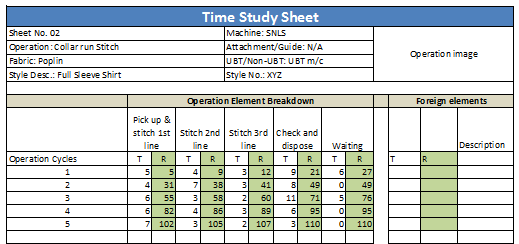 |
| Table-1: Time Study sheet |
Step 3: Calculation of Basic Time
 |
| Table-2: Time Study sheet with calculation |
Add allowances to normal time (machine allowances, fatigue and personal needs etc). Add machine allowance only to those elements where machine is running and fatigue and personal needs to all elements (approx 20%). machine allowances are shown in the time study sheet. (I have used these allowance percentage as seen seniors to use them. I don’t know the source of these allowance)
The calculated time (Normal time + Allowance time) is standard time for each element in seconds. Sum up all elemental time and convert seconds into minutes. This is standard minutes or SAM (Standard Allowed Minute).
Also Read: How to Calculate SAM for a Garment?



Leave a Reply