

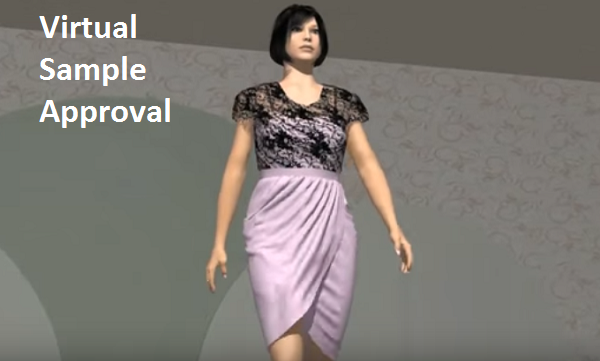
It’s time to shift to 3D virtual garment technology to minimize the sample development cost and reduce the sample lead time. The technology is called 3D virtual prototyping of clothing products.
 |
| Image source: Tukatech via Youtube |
Also, development samples are used in range selection meetings and salesman samples. If the samples do not reach buyers on time, naturally the manufacturer loses the orders. Developing samples and submitting them on time ensures continuous orders from the buyers.
Developing samples is a costly business. In most cases, fabric mills charge for the sample yardage. If the mill is not a regular source, they may even ask to pay minimum charges, increasing the development cost. As we know buyers always want to see samples in several different colorways and a few different fabric options. Getting the fabrics and trims on time, making them and couriering is a significant task and a cost to the company.
Recent developments in 3D technology, CAD systems, and rapidly evolving computer graphics technology provide an alternative solution to the sample-making process. Leading companies like Adidas and Nike already using this technology to minimize the development cost and reduce the lead time.
If we try to understand what purpose samples provide, the main reason for the development samples is to understand the designs, styling details, range compatibility, hand feel, measurements, colour combos, and drapes. By using 3D avatars companies can avoid making multiple samples in all colorways. Making one or a few samples from the actual fabric would satisfy the buyers on hand feel and the drape. The rest of the collection can be created using 3D virtual garment technology as it can satisfy all other needs for samples. When trying out new design concepts and ideas, 3D virtual garment technology provides a fast and accurate interpretation of the samples.




Leave a Reply