

It is astonishing to contemplate the versatility of the banana plant. Almost every part of the plant has a unique utility. Banana is well known as food, fruit, and fodder crop. Its leaves are an integral part of our tradition and culture and have excellent medicinal properties. After the fruit is harvested, the “pseudo stem” (trunk portion) is thrown out as agricultural waste. This pseudo stem biomass is a rich source of natural fibres, which when utilized, can generate profits by offering multiple products like pickles, fertilizers, compost, textiles, and many more.
India, being the largest producer of banana in the world with an estimated annual output of 13.5 million tons, has immense potential to utilize these assets of the plant. Around 80% of banana crop is generated majorly from six states, namely, Tamil Nadu, Maharashtra, Karnataka, Kerala Andhra Pradesh and Gujarat. Thus, the plant is of great economic importance.
The origin of banana fibres and textiles

Image 1 – Banana tree and banana fabric
Banana fabric is a great vegan alternative that has properties imitating silk. The fibre material comes from the stalk or trunk portion called the “pseudo stem” of the banana plant. While it is certainly a unique idea, it is not new. The textile made of banana fibre has been used in Japanese and Southeast Asian cultures as early as the 13th century.
How is a banana textile made?
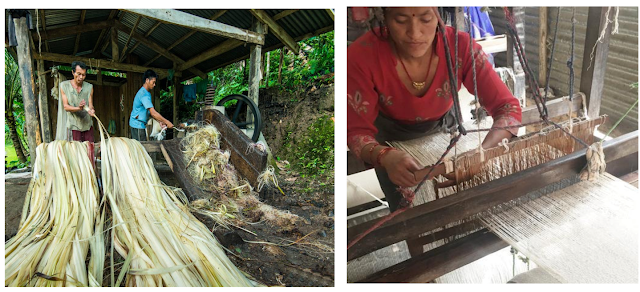
Image 2- Banana fibre extraction and weaving fabric using banana fibre
Following are the steps describing how the banana fabric is manufactured –
Step 1: Harvesting the pseudo stem and peeling:
Step 2: Extraction of fibre:
Step 3: Drying
Step 4: Grouping and knotting:
Step 5: Twisting
Step 6: Weaving
Properties of banana fibre
- The appearance of banana fibre is similar to that of bamboo fibre and ramie fibre.
- It is biodegradable and has no adverse effect on the environment and thus can be categorized eco-friendly.
- The chemical composition of banana fibre is cellulose, hemicelluloses, and lignin.
- It has strong moisture absorption quality. It absorbs as well as releases moisture very fast.
- It has a somewhat shiny appearance depending upon the extraction.
- Its average fineness is 4 to 15 tex.
- It is a strong yet lightweight with smaller elongation properties.
- The banana fibre is resistant to the action of alkali, phenol, formic acid, chloroform acetone, and petroleum ether. It is soluble in hot, concentrated sulphuric acid.
- The lignin content of banana fibre is less than jute.
- It is alkali proof and has good receptivity for the dyes
- Banana fibres can easily blend with other natural fibres for enhanced performance and properties.
For example-
Banana fibre producing countries (in Japan, Nepal, and India)
In this section, we will see countries that produce banana fibres, make banana fabrics and consume the textiles made of banana fibre.
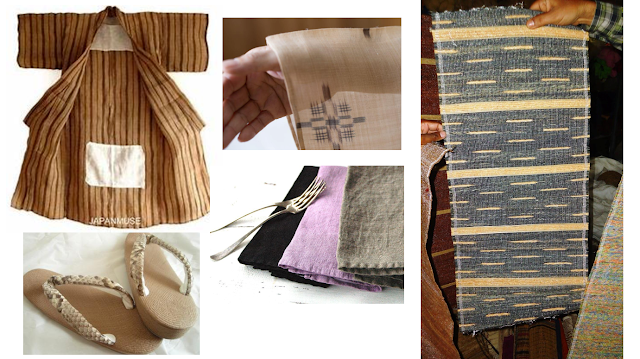
Image 3 – Products made of banana fibre
The Banana plant has long been a rich source of fibre for the preparation of high-quality textiles, especially in Japan and Nepal. Japan is utilizing banana fibres for textile production for making traditional kimono and kamishimo since the 13th century. It is still a favourite summer wear fabric choice and used for neckties, cushion covers, tablecloths and bedsheets as well. To make the textile, they cut leaves and shoots of the plant, boil them to extract fibre, and make yarn. Most of the processes are done by hand.
In Nepal, the pseudo stem is chopped into small pieces and is subjected to a softening process, mechanical extraction of the fibres, bleaching, and drying. The fibres are converted to yarn and hand-knotted by traditional Nepalese artisans of Kathmandu Valley. The hand and feel of these high-quality rugs resemble silk. These “RugMark” certified rugs enjoy global popularity and demand.
In India, annually, about 1.5 million tons of dry banana fibres can be produced from the outer sheath of pseudo stem to produce textiles with highly suitable and traditional varieties of banana plants like Red banana, Nendran, Robusta, Dwarf Cavendish, and Poovan.
Unlike other banana-growing countries like Philippines, Uganda, China, and Indonesia – banana fibres are currently not being extracted on a commercial scale anywhere in India with an exception being the Jalgaon district in Maharashtra, where The Tapti Valley Banana Processing & Products Co-operative Society is producing a wide variety of products by utilizing banana pseudo stem fibres. In the villages of Kerala, the most common method of extraction is hand scraping the pulp out of vertical strips of pseudo stem, which are chopped using a blunt metal edge. The apparent drawback of hand scrapping is low fibre output. It led to the invention of the banana fibre separator machine called Raspador which offers a simple and quicker way of extracting fibres.
Research work on banana fibres, fabrics
Anakaputhur Jute Weavers’ Association, situated near Chennai, is headed by an innovative weaver Mr. C. Sekar. Traditionally known for its handlooms, this organization is working hard to bring banana textile production back on the map by selling hundreds of sarees every year, which otherwise may have lost its identity in the urban chaos.
Mr. Sekar is encouraging weavers to make 100 per cent pure banana fibre sarees with the technical help of ICAR- NRC. These saris are supplied to both national and international markets. Although the returns are good, the work is restricted to only one weaving unit. They are facing problems in upscaling due to lack of raw material availability. He advocates a 30:30:40 blend of banana: cotton: silk for making premium silk saris, which can attract the premium segment. He has also collaborated with NIFT students in design intervention and colour combination which has enhanced the reach of his products
This traditional handloom unit is also making strives to produce products that cater to the modern consumer, hence the recently released banana fibre jeans made from cotton and banana fibre in 2017. Not only they have the look and feel of denim, but are eco-friendly (dyed naturally and use coconut shells instead of a metal button). Mr Sekar has ensured that the specially blended fabric he has woven absorbs more water than denim. These jeans are priced at Rs 5,000.
Bihar’s Hajipur is also one of the largest and finest bananas producing district in north India. The local women have started extracting fibre from the abandoned stems of banana for textiles under the mentorship of Vaishali Priya, a fashion entrepreneur who has developed a niche for herself in European export market for garments and accessories by employing women from rural areas and providing them fashion-based skills development classes under Surmayi Banana Extraction Project, where they are given training of the whole extraction process – stripping, soaking, combing, and spinning before the process starts. With the support of the local Krishi Vigyan Kendra, Priya started with 30 women at Hariharpur, a village famous for banana cultivation and has been joined by multiple locals ever since.
Applications of banana fibres
1) Shipping cables, ropes, and cordages
2) Sanitary pads
Similar efforts were made by Amrita Saigal and Kristin Kagetsu, engineering at MIT. Where they created low cost sanitary pads for rural women using banana pseudo stem fibre which is being sold by the name “Saathi” . They source the banana fibre from a banana plantation belt near Ahmedabad. Banana fibre is usually a waste product for the farmers; Saathi is helping farmers with an additional source of income from the waste.
Another IIT Delhi-incubated start-up “Sanfe” has launched sanitary pads made from composite banana fibres that can be used multiple times. Said to last up to two years or around 120 washes, the product is made using Quadrant True Lock Technology which makes the pad leakproof.
3) Currency paper
4) Bio-pesticides and organic fertilizers
The scutcher is further used to prepare compost or vermicompost.
Over the time, Tapti Valley co-operative has come up with more and more products like pickles, candies, soft drinks, handicrafts, mordants for fixing colours, etc using banana plant parts.
5) Banana Paper
6) Handicrafts
Conclusion:
The utilization of banana fibre would be an innovative method to reduce pollution effectively and to boost our economy for a better world as otherwise, a farmer tends to burn the field for clearance. Many villages in southern India have become the centre for banana fibre production wherein every household is engaged in the fibre extraction activity seeking out their livelihood. With the increasing demand for the banana fibre in both the Indian and International markets, the acreage and production are expected to rise in the coming years, thus generating more of the pseudo stem biomass waste.
Being a rich source of natural fibres, the pseudo stem can be advantageously utilized for various applications and the preparation of various products. Considering the availability and immense potential for extraction and use of the banana fibre, the Tiruchi-based NRCB plans to extract this fibre on a commercial scale. The Centre had developed products like banana figs, juice, jam, biscuits, health supplement and a baby cereal and also imparted a week-long training course to the farmers; but the major challenge that lies ahead is lack of technical knowledge and marketing expertise.
References and further reading:
- Banana yarn-Golden revolution in textiles (K. N. Shiva, S. Uma and P. Suresh Kumar)- NRCB
- Banana Fibre: Scope and value-added product development – JATM (Journal of Textile and apparel technology and management)
- Processing of Banana Pseudo-stem into Value Added Products: Attempt for waste to Wealth
- Meet the Chennai-based weaver who makes jeans from banana fibre By Think Change India
- Fashion entrepreneur helps womenfolk in Bihar make livelihood from banana fiber
- Banana pseudo-stem – The story of waste to wealth
- Banana fibre paper for lasting currency notes- The Economic Times
- Sanitary Pads made from banana fibres? IIT Delhi incubated start-up launches the re-usable product.
- Eco-friendly sanitary pads made of banana fibre – Saathi pads’s solution to menstrual waste By Snigdha Sinha
About the Author:
Aayushi Kumar, an NIFT, Kolkata graduate, Co-founder of Ednam Solutions Pvt Ltd is working in the field of female healthcare and hygiene, making smart garment. Her interests include sustainable fashion, functional garments and luxury brand management.
Update on: 04 November 2023
First publishing date: 22 Oct 2020




Leave a Reply