

Need for Pricing Decisions
Today’s market is full of alternatives for customers and customers are more knowledgeable about the options available in the market, pricing selections are becoming more crucial. As a result, they are better positioned to look for decent value when they purchase goods and services. Value is the relationship between what consumers receive (the deemed benefit of the goods and services provided by the retailer) and what they must pay for it.
Retailers can boost value and encourage more trades by lowering prices or raising perceived benefits. For some clients, A good bargain is just paying the least amount possible given the additional advantages provided are unimportant to them, according to retailers. Others are willing to pay more for additional perks if they feel they will receive value for their money in either service or product quality. Retailers’ sales and earnings will drop if their prices are higher than the benefits they offer. However, if retailers set prices too low, they may see a rise in sales but a decline in earnings due to the smaller profit margin.
Pricing Strategies
Retailers generally employ two pricing strategies: (1) everyday low pricing and (2) high/low pricing. The benefits and drawbacks of each of these tactics are described in this article.
High/Low Pricing
Through sales campaigns, retailers who use a high/low pricing strategy frequently—often weekly—discount the initial prices of goods. Some shoppers, on the other hand, get used to regular reductions and just wait for the items they want to go on sale before stocking up at the reduced costs. This type of pricing strategy is utilised by numerous large businesses (including, in North America, Reebok, Nike, and Target). The fashion and shoe industries compete in part through high-low pricing (Macy’s, Nordstrom, etc.).
Everyday Low Pricing
Many retailers have embraced an everyday low-pricing (EDLP) strategy, including supermarkets, home improvement stores, and discount stores. With this tactic, the emphasis is placed on the consistency of retail pricing at a level midway between the usual, non-sale price and the deep-discount sale price of high/low retailers. Even while EDLP merchants support their policy of constant pricing, they don’t experience sales as regularly as their high/low rivals.
Everyday low pricing is a little deceptive because low doesn’t necessarily mean “lowest.” Although EDLP-using shops aim for low pricing, they aren’t always the best deals available. A sale price at a high/low store could be the lowest price offered in a market at any particular time. True EDLP retailers, such as Walmart, Costco, or Target, almost never offer discounts because they have already beaten the industry prices.
Advantages of pricing strategies
1. Increases revenue:
Stirs up excitement during a sale, there is frequently an atmosphere of “grab them while they last.” Many people are attracted by sales, and many customers generate enthusiasm. Some shops add unique in-store events like product demonstrations, freebies, and celebrity appearances to their low prices and advertising.
2. Sells Slow moving merchandise:
3. Ensures affordable prices for clients:
4. Lowers operating and advertising costs:
5. Decreases stock-outs and enhances inventory control:
Factors for setting retail pricing
Customer price sensitivity and cost: In general, as a product’s price rises, sales of that product decline as fewer and fewer consumers think the product is a good value. How many units will be sold at various price points depends on how sensitive consumers are to price changes. If target market consumers are highly price-sensitive, price increases will have a significant negative impact on sales. Sales won’t be greatly affected by price increases if clients aren’t overly price-sensitive.
Price Elasticity is commonly used to measure price sensitivity. This is the ratio of the percentage change in quantity sold to the percentage change in price.
Competition: Customers have a wide range of options for products and services, and they frequently look for the best deal. As a result, when setting their own prices, retailers must take their rivals’ into account.
Retailers have the option of pricing higher, lower, or online with their rivals. The selected Pricing policy must be in line with the overall strategy of the retailer and its comparable market standing. Consider Walmart and Tiffany & Co. as examples. Walmart strives to undercut its rivals’ prices on the goods it sells. Tiffany, in contrast, provides its clients with important advantages that go beyond the products themselves. Customers are ensured by the company’s brand name and customer care that they will be happy with the products they buy. Tiffany is able to charge more than rivals because of the distinctiveness of its offering.
Different types of pricing
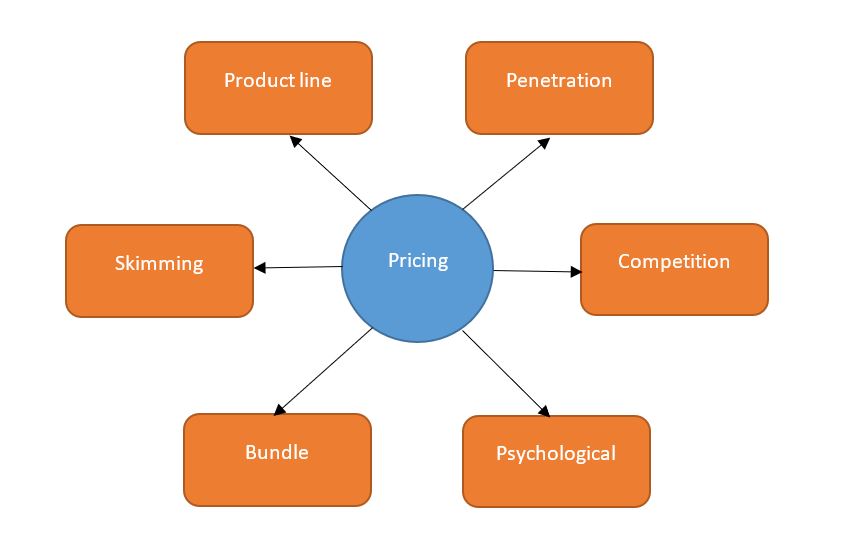
1. Penetration pricing:

2. Competition pricing:
3. Product line pricing:
4. Psychological pricing:
5. Skimming:
6. Bundle pricing:
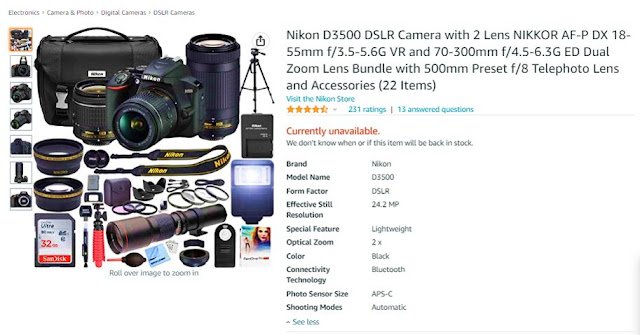
Image: An Amazon bundle example built around one major high-runner item: a Nikon camera.
Conclusion
There are several pricing methods that a business can use; the price strategy is typically dependent on corporate objectives. It is necessary to choose a pricing target before deciding on a pricing strategy. When it comes time to actually price the goods, this will help. There are many pricing strategies from which to pick, just like there are many pricing objectives. The objective should be carefully determined because some tactics are more effective with some objectives than others.
References
Levy, M., Weitz, B. A., Grewal, D., & Madore, M. (2012). Retailing management (Vol. 6). New York: McGraw-Hill/Irwin.
Zentes, J., Morschett, D., & Schramm-Klein, H. (2007). Strategic retail management. Springer.
Wang, R., Zhou, X., & Li, B. (2022). Pricing strategy of dual-channel supply chain with a risk-averse retailer considering consumers’ channel preferences. Annals of Operations Research, 309(1), 305-324.
About the Author:
Sweta Singh is currently pursuing Masters in Fashion Technology from NIFT, New Delhi, with an experience of 7 months in SGS India Pvt. Ltd. as Asst. Quality Coordinator. She has done her B. Tech in Apparel Production and Management from the Government College of Engineering and Textile Technology, Serampore.





Leave a Reply