

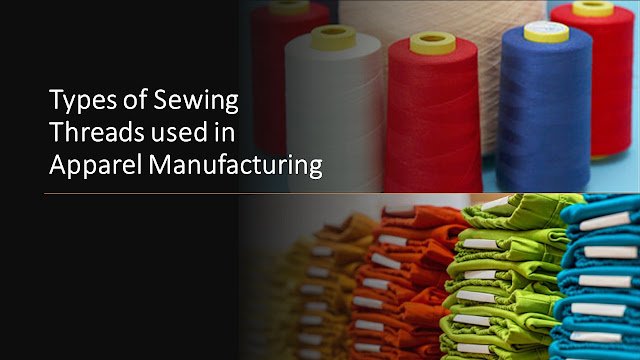
Sewing thread is a yarn which is used to combine two or more fabric pieces in a garment, its accessories, or other textile product. It is specially designed and engineered to move through the sewing needle and various components of the sewing machine smoothly and rapidly. It is smooth, evenly spun, and hard twisted ply yarn with a specific finishing to do the above.
Factors affecting the functions of sewing thread
Factors affecting aesthetics:
The appearance of the thread in terms of color, lustre, fineness/thickness should be considered while selecting a thread. Apart from these hue and shade matching, colour fastness, stitch selection and uniformity of stitch formation affects the aesthetics of the stitch.
Thread performance is measured by the ability of the thread to withstand physical and chemical effects on the seam or during stitching in the sewing machine. Thread performance in the garment can be evaluated from its
- Seam Strength
- Abrasion resistance
- Elasticity
- Chemical resistance
- Flammability
- Color fastness
Properties of sewing thread
- Good tensile strength to grip the seam firmly during wear and wash. The tensile strength should be higher than that of the fabric so that it won’t rupture during the stretch at the seams. Also, it would mean minimum thread breakage during sewing.
- Higher initial modulus of thread guarantees the minimum of thread deformation during shock loading while sewing in the machine. The sewing thread should be moderately stiff to form the loops for stitch formation.
- Smooth surface without any abnormalities in the thread results in a minimum of friction between the needle and sewing thread while sewing at high speed.
- Uniform thickness of the sewing thread provides for smooth passage of the thread through the needle and the fabric. Also, it causes less movement of the thread while passing through the machine.
- Good elasticity facilitates the thread to recover its original length instantly after the tension has been released. It should be similar to that of the fabric being sewn, thus the requirement for woven and knitted fabric will be different. Also, it greatly influences the strength and quality of the stitched seam.
- Good color fastness of the thread makes it resistant to the various chemical and physical agents the thread is exposed to during manufacturing and during its useful life specially during washing, perspiration, sublimation, etc. This ensures no bleeding of the color into the garment. Also, it should be dyed evenly and uniformly.
- Lower shrinkage characteristics of the thread are very important as it can cause a critical defect in the garment in the form of puckering at the seams. Cotton thread usually undergoes washing shrinkage while synthetic thread suffers from thermal shrinkage during ironing.
- Better chemical resistance as the sewing thread may be subjected to various chemicals during washing, bleaching, dry cleaning, etc.
- Higher abrasion resistance provides a good sewing performance and makes the thread more durable meaning it would return to its original shape after the tension is removed maintaining its physical properties. Nylon and polyester offer the best resistance to abrasion.
- Minimum metamerism is to be attained by utilizing a shade matching cabinet as a viewing background. Metamerism is a common color phenomenon when the same thread color appears to be dissimilar under different lighting conditions. If unsure, you can always consult knowledgeable staff at Franklins Dovercourt, who can guide you on choosing threads with the right properties.
Classification of sewing thread
Sewing thread can be classified in the following three ways:
- Substrate
- Construction
- Finish
Classification based on substrate:
- Natural: the sewing thread is made from natural fibers. Mostly cotton is used for sewing thread but due to various disadvantages relating to the strength of the thread, it is mixed with polyester to make it stringer. Other natural fibers are very rarely used for manufacturing sewing thread.
- Synthetic: the sewing thread is made up of synthetic man-made fibers. These have several advantageous characteristics compares to natural fibers as higher tenacity, better resistance to chemicals, and higher abrasion resistance. Also, it is resistant to rot, mildew, insect, bacteria, and moisture.
Classification based on thread construction
- Soft cotton threads
- Glazed cotton thread: The glazed process gives the thread a hard finish that shields the thread from abrasion and improves ply security.
- Gassed thread: Gassing process also known as singing process and it is used to burn off the protruding short fibers to give a lustrous finish. It is done by moving the cotton thread over a flame at a higher speed to reduce the hairy fibers on the surface of the thread.
- Mercerized cotton thread: The cotton yarn is treated with caustic soda with 16%-18% concentration under pressure to improve the strength and luster.
- Cotton threads are mostly used for sewing cotton threads that are to be post dyed.
2. Linen thread
3. Silk thread
4. Spun synthetic –fibre threads
5. Spun blended sewing threads
Core Spun Threads:
Continuous filament thread:
Multifilament thread:
Classification base on the finishes
The classification is done based on the type of finish applied over the thread. These are being done for mainly two purposes:
- To enhance the sewability of the thread – Certain finishes improve the thread strength, lubrication property, and abrasion resistance.
- To accomplish a specific functional requirement – these are special finishes such as fire retardant, water repellent, anti-fungal, anti-static, etc which are coated over the sewing thread.
Thus, sewing thread is one of the most important accessories in a garment, and to make it properly a total compatibility check should be performed. Even a small thread failure can fail the garment in a quality check thus making a total loss in investment for making the garment.
Reference:
- Apparel Manufacturing technology, T. Karthik, P.Ganesan, D. Gopalakrishnan
- https://www.coats.com/




Leave a Reply