

For Bangladesh RMG [herein after referred as BDRMG] Industry eyeing on an ambitious goal not dreamy at all amid eye-popping growth, it has met in its decades-long journey. The maturity of the industry is undisputed now. The bite of the BDRMG in the 500 billion dollars global RMG market is just smaller than China’s; in spite of odds, it had to face at home and abroad. Out of top ten LEED certified factories of the world, BD housed five, of them three topping the list. Hundreds more are in process. A somewhat calm political atmosphere has also been prevailing in the country for quite some times.
Inspired by the backdrop the industry has planned to reach 50 billion dollar milestone by 2021, the very year the country will celebrate its 50th anniversary of freedom.

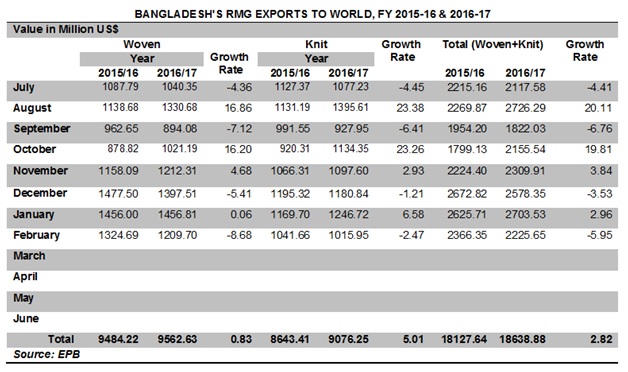
Let’s see the facts & figures approaching the milestone. Well, Dollars earned so far, well short of target. Export Promotion Bureau, Bangladesh [EPB] data show, RMG export in the first eight months of the last FY [2015-2016] stood at $28.09 billion. The first eight months [July-Feb] of the current FY [2016-2017] recorded an export of 18.64 billion, against 18.13 billion of the same period of FY 2015-2016. A mere 2.82% rise in growth. BDRMG requiring around 13% healthy growth to reach the 50b dollar milestone. With this progress report in hand, the industry has to fight in fronts at home and abroad as well, in order to maintain the growth required. Let’s look into the hurdles BDRMG has to cross over to reach the 50 Billion mark.
Peaking Costs of Production
Peaking costs of production, perhaps the major concern at home. When every segment in the FTAR industry has to bow down to meet customers’ demands for a low price, experiencing a rise in costs of production by a segment will invariably shrink growth in sales and the market share eventually. In recent times, BD RMG has encountered a sharp rise in the payrolls resulting from meeting the demands of minimum wages. Costs of production went from bad to worse when Government increased the prices of key utilities like electricity & gas. Furthermore, the Industry had to account for considerable overheads toward Compliance, especially after Rana Plaza catastrophe. The Costs of Compliance too instrumental in pushing the production costs up.
Steady Exchange Rates
Unfriendly Industrial Relations
The industry caught a nasty cold following some tragic and unwanted events headlined by different media at home and abroad. The same resulted in a drop in sales. To quiet the criticism, it went to a note-worthy length to straighten out the issues relating to workers ‘Safety & Welfare’. It seems controversies still exist concerning some workers’ rights and fulfilling their demands especially relating to the formation of trade unions. Five major buyers of Bangladesh’s RMG, H&M, Inditex, C&A, Next, and Tchibo have stayed out of Dhaka Apparel Summit 2017, in response to recent repression of workers and denial of trade union rights.
Rise of New Sourcing Destinations
With the rise of new sourcing destinations, existing sources are being opted out by the CPOs of clothing companies. Bangladesh is no exception. Markets needed to be diversified. Forking out in different destinations to explore non-traditional markets has always been a must for the sellers to maintain its growth. To counter the switching to new sources BD too has to explore new avenues to display and sell its merchandise. Over the years BDRMG’s presence in non-traditional markets felt but not as bold as traditional. A shift in concentration to non-traditional will help sustain losses in traditional.
 |
| Source: The Apparel Story magazine by BGMEA |
Lacking Diversification
 |
| Source: The Apparel Story magazine by BGMEA |
Insignificant presence in High-end markets
Switching to value added merchandise is a must for BD in one way or another. Resources here are not in abundance, and pricey too. Industry can craft products with same resources but for different price points. Implementation of 3R principles of the environment is getting weights along with usual compliance issues. Crafting value-added products in one end will help implement the principles and enable encashing more dollars on the other.
Efficiency of Supply chain
Conclusion
While crimson flickers in the distance hazy lines are ahead. If the problems above persist an otherwise reachable milestone will be out of reach, as far as stipulated time frame is concerned. Average export growth rate achieved in the last five fiscal years [2011 to 2016] is around 10%. If we compare this with the 13% asking rate, as assumed, a short of 5-6 billions may be affected. Whatever the problems are, 50b milestone is yet within reach if BDRMG could fight well on two fronts i.e. increasing growth in non-traditional territories and switching to high-end merchandise more significantly. Encouraging are the enthusiasm of makers as a whole and the tranquil political climate prevailing now at home. With these in hand, a concerted effort by all stakeholders could yet transform the dream into reality.
About the Author:
 Sharfuddin Ripon has worked in the RMG factories in Bangladesh from 1990 to 2010 in various positions starting from Merchandisers to Executive Director in the end. At present he owns and manage XL Fibers, enterprising in garment inspections and buying services. Associated with BGMEA Institute of Fashion & Technology, BIFT, Chittagong as guest faculty on Apparel Merchandising. Read more from the author in his blog Quality Fashion Lines.


Leave a Reply