

What is the line layout?
The sewing line layout can be defined as the way sewing workstations are placed in the sewing floor to form a line (or batch) that works on single style. The purpose of choosing one line layout over other is to achieve best production with existing resources.
Different Types of Line Layout
Though there are multiple options of sewing line layout to choose from, most garment manufacturers are comfortable with straight lines having center table in between two rows of machines.
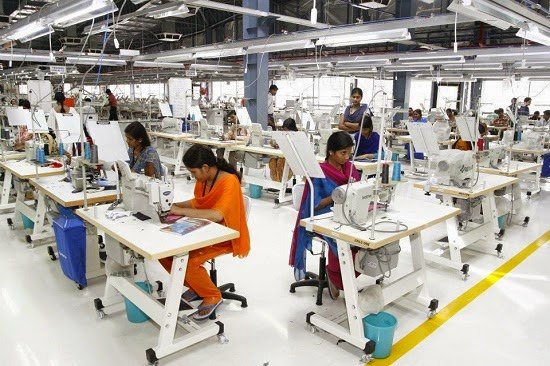
1. Line with center table and operators facing same direction (Figure-1):
In the line a centre table is placed in between two rows of sewing machines. All operators sit on workstation facing same direction. Operators pick bundles from center table and after stitching dispose bundles on the center tables.
 |
| Figure 1: Straight line. Image courtesy: Denim Experts, Bangladesh |
2. Line with center table and operators facing opposite direction (Figure -2)
 |
| Figure-2. Straight line operator facing opposite direction Image source: Stitch World via Facebook |
3. Straight line without center table and one raw of machines
In this layout no center table is used for material handling. Instead cutting and finished garments are kept of hangers, on baskets or on trolleys. See the different form of layout where machines are placed in a straight line but no center table is used.
 |
| Fig. 3: Straight line layout with overhead material transportation Image courtesy: Sahu Exports |
(b) Trolley for material transportation (Fig-4): In this layout instead of center table trolleys are used for material transportation.
 |
| Fig-4: Straight line layout with trolleys |
(c) Line having individual disposal basket (Fig-5): Instead of centre table individual disposal baskets are provided to operators.
 |
| Fig-5: Straight line layout with individual disposal basket Image source: Stitch World via Facebook |
4. Side by side machine layout (Fig -6):
In this layout sewing machines are placed side by side. Two rows of machines are faced each other. This type of layout is used for single piece production system.
 |
| Fig -6: Side by Side machine layout Image source: Alibaba.com |
5. U-shaped line layout (Fig – 7):
This kind of line layout is used in lean manufacturing. Machines are placed side by side and U-shape is formed to make a line. Operators sit inside. No center table is used. This line layout is also known as modular line.
 |
| Fig. 7: U-shaped line layout. Image source: Stitch World via Facebook |
6. Modular line layout:
In lean manufacturing, to reduce material transportation and increase the machine utilization sewing machines are placed in such a way that neither it forms a U-shape nor a straight line. Instead machines placed that suits better to work into multiple sewing machines sitting in single chair. I don’t know what the exact name of this kind of layout is. This layout is named as modular layout to differentiate from the above one.
7. Machine layout in UPS system (Fig-8)
 |
| Fig-8: Line layout in UPS system Image source: Unknown |
Conclusion:
Now it is upto you. You may choose one layout for your factory from the above list. When one layout is selected out of above, you need to consider the following fine points
- Space utilization – Space required per workstation compared to another line layout
- Means of material transportation
- Order volume and shipment lead time
- Production systems to be implemented
PS: If you have a different layout in your factory, take a snap of the line and share with us in Facebook page or send me by mail.





Leave a Reply