

The prerequisite of this method is to have a skill matrix of sewing operators. Normally, at the time of line setting, operators are selected based on their experience on operations. The calculated skill level of the operators on the operations is not considered at all.
As a result, after a couple of hours, high skilled operators start sitting idle and low skilled operators stuck with their work. This line becomes imbalanced and a lot of productive time is lost as operators sit idle. To utilize operator’s maximum capacity, work allocation must be done based on operator’s potential performance level (efficiency) and work must be shared with operators who have excess capacity.
Assume that you already have skill matrix of your operators. For example, a line produces Tee shirt and skill inventory of the operators are as following. Operator’s skill levels in various operations have been shown in the following table-1.

Work sharing between the operators may vary depending on production systems. I will explain line balancing method considering that we are balancing an assembly line (Progressive Bundle system). Assumptions:
- Operators will work on a single workstation.
- Work will be shared or operator’s excess capacity will be utilized only where machine type matched and the operator has performed that operation earlier (refer to operator skill inventory)
- No time delay when an operator switches from one operation to another.
Step 1: Keep a copy of the skill matrix of all operators working in the sewing line where new style will be loaded. Or you can prepare it if you don’t have one.
Step 2: Collect Operation bulletin (OB) for the style to be loaded or is running on the line. Operation bulletin must have information such as Operation name, SMV of the operations, type of machine is used and hourly target from the line. Refer to following OB. Daily target output is 675 pieces in 8 hours shift and hourly target is 85 pieces.
Figure-1: A Basic Operation Bulletin (For a Tee for example only)
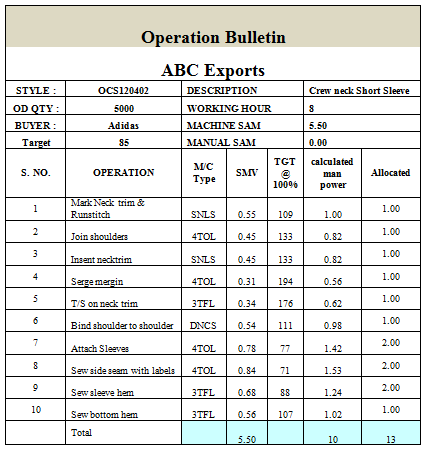
Step 3: Prepare a table on spread sheet with the headers as shown in the following Figure-2. Enter information to this sheet from your operation bulletin. Columns A, B, C and E to be filled from OB.

Step 4: Other columns and formula used for calculation are explained in the following paragraph. Insert formula in your spreadsheet as explained here.
Standard output (D): Potential production at 100% efficiency. D= 60/ SMV of an operation
Operator (F): Operator name to be entered after selection from skill inventory.
Potential performance (G): It represents operator’s efficiency level in the past on the listed operations. Information will be selected from skill history.
Hourly potential output (H): Number of pieces expected from the operator based on his/her past performance. H= Standard output X operator’s efficiency%
Time Available (I): Time available to an operator in hours at the time of starting of a task. If an operator spends 0.5 hours in an operation, he will have 0.5 hours for another operation.
Over and under production (J): It is the variation of potential output against target output. Negative (-) sign represents underproduction and no sign represent overproduction. J = (Hourly potential output – Hourly target production)
Time needed to make target production (K): Operators time needed to produce target output. K = (Hourly target production/ Hourly potential output)
Spare Time (L): Excess time than the time required to produce target quantity. L = (Time available – Time need to make target production)

I hope you have understood above explanation on line balancing using skill history. For further clarification, you may write us or enter your comments below.




Leave a Reply