

Engineers and production managers always look for a way to
improve the factory’s labour productivity. But they look over things that lower labour productivity. “Higher line setting
time” is one of the most visible reasons at present that reduces factory’s
overall productivity. When it takes a longer time for setting a line, most of the
operators sit idle. That means operators are not utilized in producing garment
and operator productivity falls resulting in high labour cost. Following piece of
article will help you to reduce line time.
improve the factory’s labour productivity. But they look over things that lower labour productivity. “Higher line setting
time” is one of the most visible reasons at present that reduces factory’s
overall productivity. When it takes a longer time for setting a line, most of the
operators sit idle. That means operators are not utilized in producing garment
and operator productivity falls resulting in high labour cost. Following piece of
article will help you to reduce line time.
I have seen factories where 1.5 to 2 days are spent in line
setting for woven tops. When line supervisor and engineers are asked why they are
taking that much time to set a 40 machines line, they give dozen of reasons.
Whatever reasons line supervisor have, is the root cause for the delay. Reasons
may vary from time to time or style to style.
setting for woven tops. When line supervisor and engineers are asked why they are
taking that much time to set a 40 machines line, they give dozen of reasons.
Whatever reasons line supervisor have, is the root cause for the delay. Reasons
may vary from time to time or style to style.
Why a line setting takes longer time
Let’s discuss the main points that cause longer time for line
setting.
setting.
- Factory starts loading new style to the line once all
operators get free from the previous style. - Frequent change in line planning.
- All trims have not been approved or not yet sourced. Until
required trims are sourced all operation can’t be started. - Few garment components have been sent outside for printing or
embroidery but did not receive on time. - The supervisor did not fully assess the operation sequence or
skill requirement for each operation. - Operators were not present in the initial operations or critical
operations. - The quality issue, a supervisor not able to give a suitable operator
for the critical operation - Maintenance guy is not able to set-up the machine quickly. Replacement
of machine, setting guides and attachment takes a longer time than it should be. - Planning for larger bundle size. At the first day of line
setting if bigger bundle size is used then it will take a huge amount of time to
reach the bundle at the last operator.
 |
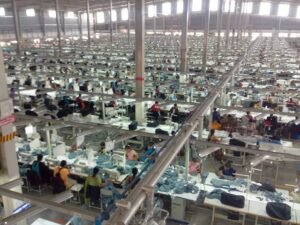
| Image Courtesy: Denim Expert Ltd. Bangladesh |
Tips to reduce line setting time
Now
it becomes simple, to start working on reducing line setting time. Work on the
above reasons and eliminate them prior to starting the line set-up. Once you
know the reason you can resolve it. In the following list, few remedies have been
explained.
- Research
and development of the style – analyse the style well before putting on the line.
By doing so, you will be aware of critical operations, machine requirement, skill requirement for the operations. - Production
file properly checked at the time of receiving from merchandising team – check
whether trims are approved or not, if not sourced yet when it is expected. Plan
you your line setting according to availability of goods. - Prepare
line plan with manpower requirement for specific skill categories. Ensure that
operators selected for the operations are present during line setting. - All
necessary attachments, needles, guides need to be arranged well in advance and
tested in sampling or Research and development centre. - Dedicated
maintenance and quality personal to be provided during line setting. - Start
setting a line with a small size of bundles (3 to 5 pieces per bundle). Thus
bundle will move fast at the end of the line. Once WIP is build up bundle size
can be increased. - Use
machine shifting device for replacing machine quickly.
Related Topics:
How to calculate SAM for a garment?
Garment CM cost estimation using SAM or SMV
The Concept of Operator’s Performance Rating
How to calculate the efficiency of a batch or line?
How to calculate operator efficiency at work?



Leave a Reply