

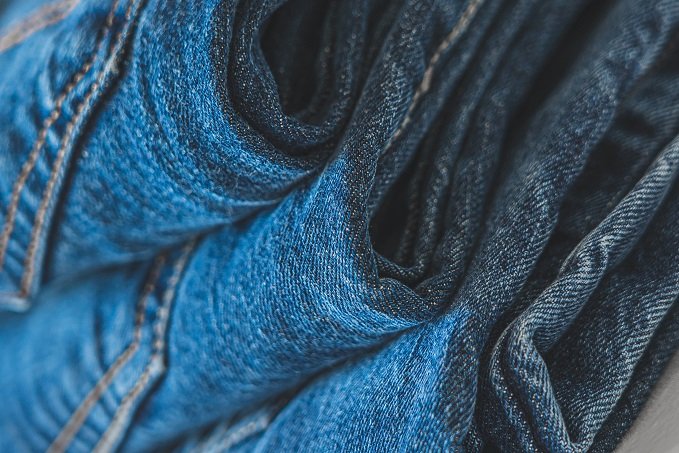
As I am working in a denim jeans manufacturing factory which is basically a washed garment, I know very well that achieving the propitious measurement according to the specification sheet can turn out to be a nightmare especially when the tolerance is less.
There are many challenging factors that affect the after-wash measurement of the garment. I will walk you through the key points to remember to achieve the correct measurement of your denim jeans and other denim apparel.
Considering the fabric quality, type, and composition of fabric meeting the client’s spec sheet, there is a chain of processes that are interlinked together to get the desired measurements.
1. Shrinkage testing of denim fabric
The first is the shrinkage coupons (Denim fabric swatch of 50 x 50 cm marked with textile marker) which are washed in the production conditions to check the actual shrinkage of the fabric in that required particular wash.
Shrinkage is basically a phenomenon that occurs after treating the fabric either with a permanent (chemical) or physical process. It can be either positive (growth) or negative (shrink).
The result is the base information that is used for further processes to obtain compact measurement after wash.
Quick note:
2. Relaxation of denim fabric
Relaxation of the fabric is a crucial step and depends on the type of fabric which is being used. It is a healthy practice to relax the fabric minimum of 24hrs for stretch fabric before cutting and a 2hrs minimum on the cutting table. This is required so that the fabric gains its original shape and is dimensionally stable after cutting. This is a mandatory process that should be practiced.
The biggest role after relaxation of fabric for measurement is played by the roll allocation (grouping of lots for shrinkage) and how we allocate it. Generally, this depends on which clients we are working with and the capacity of the CAD.
This will define the range of measurement which will be obtained after washing.
Quick note:
3. Adding stitching allowances into patterns
To add on, the stitching allowance in production should be maintained uniformly. If not regulated and checked constantly, this can give + or – deviation in the trouser before wash which can turn out to be a major concern.
Quick tip:
4. Following the right washing process
Apart from all the other things, the type of washing (amendments in washing to obtain the shade during production) plays a very vital role in the shrinkage and measurement of the garments. Same fabrics react differently with the different wash processes.
It is mandatory for the laundry department to respect the washing recipe throughout all the processes.
The temperature of the dryer and no. of times of the dryer is the salient factor in the measurements. Usually, it is recommended to run the dryer at 70 degrees but can be amended as per the requirement.
This should be maintained well to avoid catastrophe. It is good to measure the first bulk before proceeding to regulate the temperature.
About the Author:
Ashish Gupta is a Bachelor in Fashion Technology from NIFT. He is a certified PMTS (timeSSD) practitioner and currently working as Technical Process Developer in a denim plant located in Egypt.



Leave a Reply