

Shirt manufacturing process is explained in both scenarios.
Order Receiving
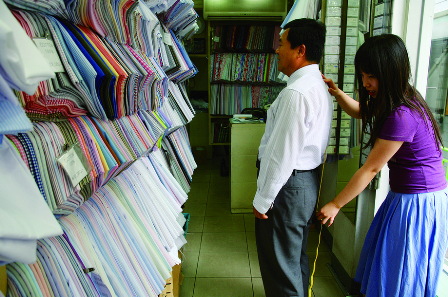
Shirt making factories get orders from brands, international buyers or retails stores. Where tailoring shops get order directly from customers. If you consider export order manufacturing, there are many preproduction processes followed by factories. Like sampling of the shirt, fabric development (factories could not just buy fabric from the market, but they need to develop fabric as per customer requirement), lap dip approval, pre-production sampling, approval of fabric and trims, development of various trims etc. Factories get an order for multiple sizes (S, M, L, and XL) and with size wise order ratio.
 |
| Image via Flickr user Seoul Korea |
Material Sourcing
Tailoring shop: Customers purchase fabric and give to tailor for making shirt for them. Other materials like sewing threads, buttons, fusible interlinings and sourced by shop owner. Formal packing is not necessary here, so no packing accessories are purchased.
Material Inspection
Fabric and trims are checked by qualified checkers. Segregation of defective materials is done from good materials. The purpose is to get quality shirts after stitching and finishing. Factories use fabric checking machines to speed up checking process and make quality checking process more effective. Sometimes factories get fabrics with shade variation. They segregate different shades and make shade bands. Later cutting is done shade wise (lot wise). The purpose is to eliminate fabric shade variation in shirts.
Pattern Making
In a tailoring shop shirts are made according to wearer’s measurement (Made to Measure). Each shirt is unique. So normally shirt patterns are not made in tailoring shop. Instead tailors (master) directly mark on the fabric and cut fabric.
In factories where hundreds of garments are made for same size and same measurement, pattern is essential. Sample shirts are made first to check that patterns are made correctly. As factory needs to make shirts for different sizes, pattern grading is done and patterns are made for all sizes. Pattern grading can be done using CAD system.
Cutting of Fabric and Fusing Material
Fabric is the major cost component in a garment. So, before cutting marker making is done wisely to increase fabric utilization. Marker making and cutting can be done using computer controlled machine.
For checks and stripes customers want checks and stripes should match in between shoulder and sleeve, left front and right front panels, even in side seams. To match checks, garment components need to cut accordingly.
Shirt Stitching
Tailors or sewing operators make shirts using sewing machine(s). First, Shirt parts are made.
Parts making: Collar, Cuff, Pockets, Front part, and Sleeves are made separately. Main label (Brand labels) is attached inside back yoke or collar band during part preparation.
Assembly: Once different parts of a shirt are made, shirt parts are assembled. In assembly section, wash care label attached to side seam.
Shirt Finishing
In finishing stage, buttons are attached to collar, cuffs and in front placket. Button holing is done on these parts. Uncut thread tails are trimmed. Other finishing sub-processes include stain removing, alteration of defective shirts and pressing. In case washing of shirt is required, factories wash shirt to give desired hand feel and aesthetic look.
In tailoring shop shirt washing process does not exist. Still in tailoring shops button holing and button attaching operations are done by hand (cost of button holing and button attaching machine is not cost effective for tailoring shops).
Quality Inspection
Shirts are finished and ready to fold and pack. Before packing, shirts are checked to ensure that no defective shirts are sent to the customer. If a defective garment is found, alteration or repairing is done.
Shirt Packing
This is the last process for the manufacturers in shirt making. All shirts are folded nicely using cardboard, tissue paper, pins etc. Hangtag and Price tags are attached to the folded shirts. Folded shirts are packed into a polythene bag and then packed into a cardboard box. Packing of a shirt is done as per buyer’s instruction.
Shipping of Shirts to Customer
Packed shirts are sent to customers. Retailers display shirts in their shop from where we buy our shirts. Shirt making process is complete here.
I hope you enjoyed this article. Help your friends to know the Shirt Making Process by sharing this article with them.




Leave a Reply