

 |
| Figure -1: Jeans back pocket |
Performing critical operations in garments require a high skill set. They are more prone to defects and rework when manually operated, ruining the aesthetics of the garment. Attaching back pockets on denim is one of the crucial operations. Pockets are not only functional but also contribute to the aesthetics of the garment, forming an important part of fashion. Since they are very prominent in garments, perfect workmanship is imperative, especially when functionality is combined with decoration.
Back Pocket Attaching Machine – Basic Level
The basic level of technology involves creasing and sewing operations being performed manually and is controlled by the skill of the operator. The equipment used in this level of technology includes iron for pressing and lock stitch machines. The operator first places the pre-hemmed patch pocket on a template and folds the three edges. To mark the creases, it is ironed. Then, the pocket is placed correctly on the back panel as per the marking and attached using a single needle lock stitch machine, followed by the second stitch (Figure 2). The total SAM of these operations is 1.95. Sewing line manufacturing denim using the basic level of technology produces approximately 1600 pairs of jeans in a day (8 hr shift).
 |
| Figure 2: Manual Operation to Fold and Attach Back Pocket[3] |
The number of operators required to carry out these operations –
- A helper to perform the creasing using iron
- Operator 1 to attach the back pocket using lockstitch machine
- Operator 2 to perform the 2nd stitch using lockstitch machine
Back pocket attaching in jeans is done generally by double line of stitching, but not parallel stitching lines. Therefore even though pocket attaching and topstitch operations could be done in combination by a double-needle lock stitch machine, it cannot be used to get a similar look. When stitched using single needle sewing machine, the quality depends on operator skill and any inconsistency in spacing between sewing lines will be visually unappealing. Secondly to achieve perfection operator will be slower at the basic level. The efficiency of the operator is around 65-70%. Thus, to combat the issues of quality and productivity, jeans manufacturers are opting for higher levels of technology as discussed further. Table 1 shows specifications of two models of SNLS machines that can be used for sewing denim jeans, and specifications of a typical ironing unit is mentioned in Table 2.
Table 1: SNLS Machines in Basic Level of Technology
|
Basic Level of Technology- SNLS Machine
|
|||
|
Parameter
|
Units
|
JUKI
|
Brother
|
|
Model No.
|
|
DDL-9000C
|
S-7300A-305P
|
|
Max. sewing
speed |
SPM
|
5000
|
4500
|
|
Max. stitch length
|
mm
|
5
|
7
|
|
Needle Bar
Stroke |
mm
|
30.7
|
35
|
|
Feed Dog
Height |
mm
|
0.8
|
|
|
Lift of the
Pressure Foot |
mm
|
1st step:
max.8.5
2nd step:
max.13.5 |
Presser bar
lifter: 6
Knee lifter:
16 |
|
Size of Bed
|
mm
|
517 X 178
|
|
|
Machine head
drive |
|
Compact AC
Servo motor |
AC servo motor
|
|
Power
Consumption |
VA
|
520
|
450
|
|
Power
Consumption |
kW
|
0.442
|
0.3825
|
|
Cost
|
INR
|
92,000
|
|
Table 2: Specifications of a Vacuum Ironing Unit
|
Basic Level of Technology- Vacuum Ironing
|
||
|
Dimensions
|
inches
|
30 x 48 x 36
|
|
Weight
|
kg
|
60
|
|
Voltage
|
V
|
230
|
|
Power
|
kW
|
0.37
|
|
Cost
|
Rs
|
20600
|
Jeans Back Pocket Attaching Machine – Intermediate Level
With the up-gradation in technology, semi-automatic machines ease the work of the operator; ensure more accurate work, as well as speed-up the process. Automatic pocket creasing machines and semi-automatic pocket attaching machines have been considered as the intermediate level of technology. An operator creases the back pocket using the pocket creasing machine; the creased pocket is then taken to the pocket attaching machine, which is handled by another operator.
The specifications of pocket creasing machine and pocket attaching machines (for pre-creased pockets) are shown in Table 3 and Table 4 respectively.
Table 3: Automatic Pressing-Creasing Unit Specifications
|
Intermediate Level of
Technology- Automatic Creasing Machine |
||||
|
Parameters
|
Units
|
NGAI
SHING |
SOKIEI
|
SIP
Italy |
|
Model No.
|
NS-9085-D-L
|
BY-P102
|
001-SIP
|
|
|
Dimensions
|
mm
|
840x970x1470
|
1000x725x1260
|
2050x1650x1400
|
|
Gross Weight
|
kg
|
350
|
272
|
450
|
|
Pressing- Iron
Width
and Length
|
mm
|
250 x 250
|
250 x 250
|
|
|
Average Production
Capacity
|
pockets/ hour
|
250-300
|
300-450
|
400
|
|
Die Change Time
|
|
|
3 minutes
|
|
|
Power
|
|
AC 220V, 50HZ,
Single Phase
|
AC 220V, 50HZ, Single Phase
|
AC 220V, 50HZ, Single Phase
|
|
Power Consumption
|
kW
|
4.2
|
3.4
|
10
|
|
Price
|
|
|
3,50,000
|
|
 |
| Figure 3: Automatic Pressing-Creasing Unit for Patch Pockets |
Table 4: Semi-Automatic Pocket Attaching Machine Specifications
|
Intermediate Level of
Technology- Pocket Attachment Machine |
|||
|
Parameters
|
Units
|
JUKI
|
Vi.Be.Mac
|
|
Model No.
|
|
AP-874S
|
VBM 2516V4 DCT
|
|
Sewing Head
|
|
single
|
double
|
|
Stitch Type
|
|
301
|
301
|
|
Max Sewing Area
|
mm X mm
|
250 X 250
|
305 X 250
|
|
Clamp Sewing Area
|
mm X mm
|
|
250 X 247
|
|
Stitching Length
|
mm
|
0.1~6
|
from 0,1 to 20
|
|
Max Sewing Speed
|
SPM
|
4000
|
2500
|
|
Process time
|
seconds/ pocket
|
9.9
|
|
|
Daily Production
|
no. of pockets/ operator
|
2237
|
|
|
Time Required To Change Clamps
|
|
5 minutes
|
5 minutes
|
|
Storage Of Pattern Data In The Memory
|
|
Max. 999 pattern
|
512 patterns internal memory + USB
|
|
Power Consumption
|
VA
|
820
|
|
|
Power Consumption
|
kW
|
0.697
|
|
Semi-Automatic pocket setters have been specifically designed for being capable of placing the next sewing pocket while engaging in placing the current pocket (preliminary folded) on the garment body and sewing it. They are available in single sewing head as well as double sewing head (for multi-colour thread). The machine is equipped with direct-drive lockstitch programmable electronic pattern sewing head, by adopting a simple template clamp which is easily exchangeable. These pocket setters ensure high quality and high production efficiency can be reached without the need of any skilled operator. The productivity the machine offers is 1200 pairs/8-hour shift, which is nearly five times the number produced in basic level by the same number of operators manually. Semi-Automatic pocket setter units are shown in Figure 3.
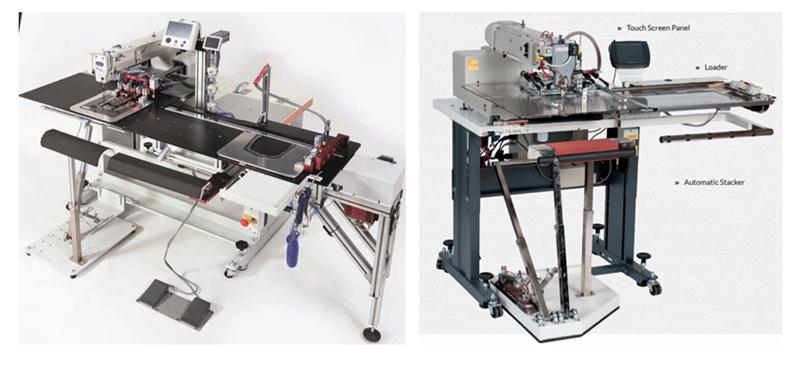 |
| Figure 4: Semi-Automatic Pocket Setter Unit (for Pre-Creased Pockets) |
Related article: Jeans waistband attaching machine
Jeans Back Pocket Attaching Machine – Advanced Level
Automated solutions ensure good and consistent quality with high output performance. Although the first thought of an automat seems to be a matter of investment and concern, manufacturers need to focus on an enlarged analysis, understanding the technicalities in detail and thinking of medium and long term goals. The fully-automatic workstation that makes all the pocket setting processes such as creasing of a pocket, placement of the pocket on the panel, sewing, bar-tack, and stacking automatic come under the advanced level of technology.
In both the lower levels of technology, the folding devices were not suitable for stretch denim fabric, but fully automatic machines are equipped with a cold folding device which is the unique solution for such fabric. The versions of these machines have single and two sewing heads. Two sewing heads can produce extra 25% as compared to single head pocket setter unit. Also, two sewing heads give the opportunity to stitch a pocket with two different colour threads. Specifications of fully automatic pocket attaching machine (single and double head) are shown in Table 5.
Table 5: Specifications of Fully Automatic Pocket Attaching Machine
|
Advanced Level of
Technology- Fully Automatic Pocket Attaching Machine |
|||||
|
Parameters
|
Units
|
SIP Italy
|
JUKI
|
PFFAF
|
PFFAF
|
|
Model Number
|
PS342-FG2SIP
|
AP-876
|
3588
|
3589
|
|
|
Stitch Type
|
301
|
301
|
301
|
301
|
|
|
Complete cycle time
|
secs
|
6
|
10
|
9
|
12
|
|
Average production
|
pairs/ 8 working hours
|
1200
|
1100
|
1200
|
1300
|
|
Sewing head utilized
|
two heads
|
single head
|
single head
|
two heads
|
|
|
Max. Sewing Speed
|
SPM
|
3000
|
4000
|
4000
|
4000
|
|
Stitch Length
|
mm
|
3.5
|
0.05 – 12.7
|
||
|
Power Consumption
|
kW
|
1.4
|
1
|
||
|
Sewing Area
|
mm
|
250 X 250
|
250 X 250
|
250 X 250
|
|
|
Dimensions of the workstation
|
cm
|
290x170x140
|
192x120x 170
|
192x120x170
|
|
|
Price
|
INR
|
30,64,000
|
20,80,000
|
19,60,000
|
39,20,200
|
As discussed earlier, for operating this automat, the operator skill required is low. However, it is unethical to lower the salary of the already existing operator if a new machine is brought in the manufacturing unit. Thus, to have a better return on investment, instead of 1:1 man to machine ratio, 1:2 ratio can be configured. For 1:1 ratio (single head machine), the SAM value for a single operation is 0.430, and that for 1:2 ratio drops down to 0.248. (Mondal, 2019). A helper transports the completed pieces from the stacker to the next operation of jeans sewing. Models of fully automatic back pocket setters are shown in Figure 5.
 |
| Figure 5: Fully Automatic Back Pocket Setter |
ROI Calculation for different technology level
To evaluate the efficiency of investing in higher technology, Return on Investment (ROI) and Payback Period are suitable performance measures. However, these two factors are not solely responsible for decision making to make an investment. There could be several other reasons for technology up-gradation, one being their goal to be state-of-the-art manufacturers.
The formulas used for ROI and payback period calculation are:
- Production per annum= (Shift hrs X 60 X Working Days X Months X Operator Efficiency) / SAM
- CM Price per Pocket= (Sewing Cost/ Total SAM of Garment) X Pocket Setting SAM
- Cost Output per annum= Production per annum X CM Price per Pocket
- No. of Machines Required= Production Target/ Production per operator per day
- CM Price per Machine= Cost Output per Annum X No. of Machines
- Cash Inflow= CM Price from Machines – Total Machine Running Expense per Annum
- ROI for 1st Year= Cash Inflow/ Depreciated Value of Machine after 1 Year
- Payback Period= Total Machine Cost (Investment)/ Cash Inflow
Key Performance Indicators
Key Performance Indicators are crucial to direct the team in a project by creating an analytical basis for decision making. With a matrix depicting the KPIs that automation improves (Table 6), it can aid one in making correct decisions for the betterment of the organization.
Table 6: Key Performance Indicators
|
Parameter
|
General Purpose M/C
|
Semi-Automatic Pocket Setter
|
Fully-Automatic Pocket Setter
|
Comparison of
Basic & Advanced
|
|
Daily Production
|
200
|
1500
|
1400
|
Increased 7 fold
|
|
Process Time
|
120 s
|
38 s
|
23 s
|
Process time reduced by more than a minute
|
|
Manpower
|
8 + 2
|
1 + 1
|
1 + 1
|
No. of Operators reduced by 7
|
|
No. of Machines
|
8
|
1
|
2
|
No. of machines significantly reduced
|
|
No. of Processes
|
3
|
2
|
1
|
No. of Processes reduced by 2
|
|
Power Consumption
|
Rs. 32428
|
Rs. 20452
|
Rs. 9984
|
Annual power consumption one-third
|
|
Suitability for diff. material
(stretch fabric) |
No
|
No
|
Yes
|
Stretchable denim fabric can be processed
|
References
- Jana, D. P., 2017. Automation has now become relevant and ‘affordable’. Industry 4.0, December, pp. 17-19.
- Jana, P., 2018. Automation in Sewing Technology. In: R. P. Rajkishore Nayak, ed. Automation in Garment Manufacturing. s.l.: Woodhead Publishing, pp. 199-236.
- Mondal, P., 2019. Sewing Automat Solution for Jeans Manufacturing. Annual Journal of TANTU Textile Alumni Association, September, Volume 7, pp. 30-33.
[1] https://www.zionmarketresearch.com/report/denim-jeans-market
[2] https://sourcingjournal.com/denim/denim-innovations/levis-laser-automation-denim-124738/
[3] https://www.thelaststitch.com/how-to-sew-jeans-back-pockets/



Leave a Reply