

The purpose of this article and a few more to follow over the next few weeks is to remind you that, as a manager/ supervisor you already know most of the lean tools and how to use them. One such tool is called 5 WHYS.

5 WHYS is one the easiest and fundamentally most important tools we use in Lean Management. It is often the case that when we do things, things go wrong. It’s normal and if things don’t go wrong there is something not normal with that setup. When things go wrong the supervisor/ manager must resolve the issue and set things right as quickly as possible.
So what is 5WHY?
It is well noted that most problems have several layers attached on top of each other. During the 5WHY route cause analysis, you’re simply peeling away each layer to get into the core of the issue which we call the fundamental cause for the problem or trigger point. Without getting to the core issue, it is practically impossible to eliminate the issue or guarantee that it won’t happen again. Sometimes we may find we do not have an answer to the issue but at least now we know what’s causing it so we can keep sufficient allowances to compensate for the delays or other impacts on the operation.
5 WHY Process
Depending on the nature of the problem you can do this 5 WHY analysis formally or informally. The formal way to do the analysis is as follows,
- Gather the team to a one-place
- Identify the problem and write a problem statement
- Ask the first WHY the problem happened and write down the answer
- Ask the second WHY and write down the answer. Now relate the answer to the first why and see any relation or correlations there
- Repeat the same until the team agrees on the core issue to the identified problem in the problem statement.
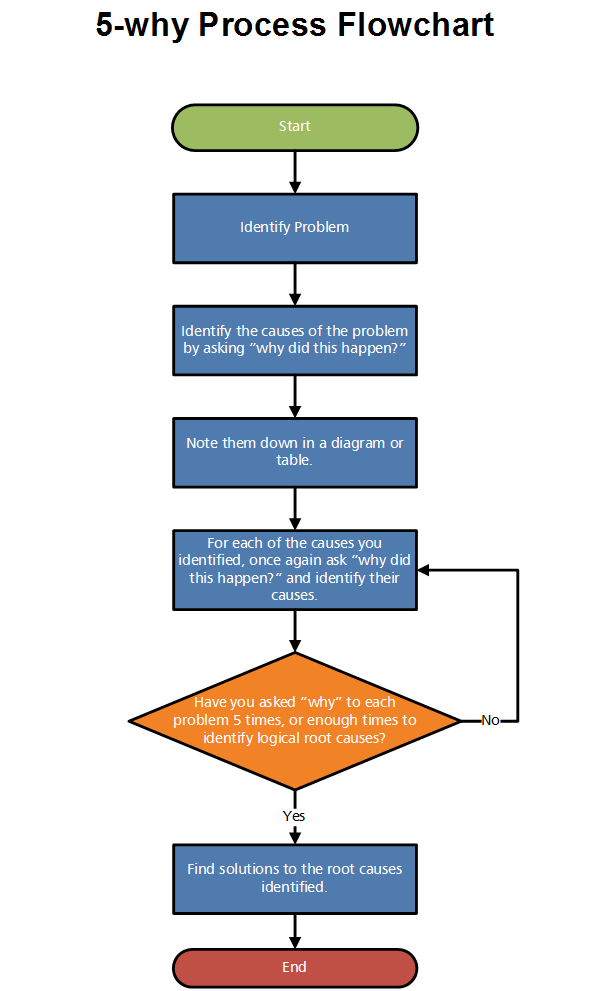
5 why process flow chart/image | source: buffer.com
Example#1:
Let’s take an example to see how 5 WHY can be used in a practical situation. Absenteeism is one of the biggest problems in the apparel industry. This causes many headaches not only to the factory manager in the manufacturing plant but everybody across the supply chain, including the buyer. But unfortunately, this is the least explored area in many apparel companies in South Asia. Some companies get around this issue by having a number of ‘jumpers’ who are multi-skilled operators who could replace absentees. But this is a costly exercise and most cases not practical as in some factories absenteeism rate is as high as 6-8%.
During one of the projects we identified absenteeism is particularly bad in one of the factories and most of the measures HR came up with not working. Some of the measures were taken to give high monetary bonuses for attendance and gifts for the best attendance. Still, the issue persists.
So we took a few employees along with the HR manager & factory manager and used 5WHY
1. Why were you absent yesterday?
3. Why do you always say NO?
Also knowing how many operators going to be absent on a particular day or a week allows the manager to plan ahead with the minimum impact to the production.
So in the above example, as a result of the 5WHY route cause analysis company identified the fundamental HR management issue they had for a long time and caused so many disruptions to their operations. After the analysis, their absenteeism went down to 3-4% within a month which was a huge improvement.
Example#2:
Let’s look at another common occurrence on the manufacturing floor. The daily production target is supposed to be 1000 pieces. However, the actual output is 890 pieces. Let’s do a route cause analysis to diagnose the issue.
1. Why was the daily target not achieved?
Answer: Line supervisor – We ran out of thread & we had to rewind the thread to get the number of cones needed. Especially for 5-thread overlock machines.
Answer: Production Manager – It seems thread consumption was taken wrong.
3. Why do we get the wrong consumption?
(a) Merchandiser – I measured the thread consumption manually. I thought I got it right. It seems there was a mistake somewhere. Sorry




Leave a Reply