

Author: Aayushi Kumar
A lifting plan provides an information on how to create specific weave structures on dobby or table loom. This format is an alternative to tie-up format which is generally used for floor looms.
- Weave plan matrix (Drawdown)
- Draft plan matrix (Threading pattern on harness)
- Lift plan matrix (sequence of lever/peg lifting)
Let us understand each component by considering an example shown below.
Step-I: Preparing the weave plan
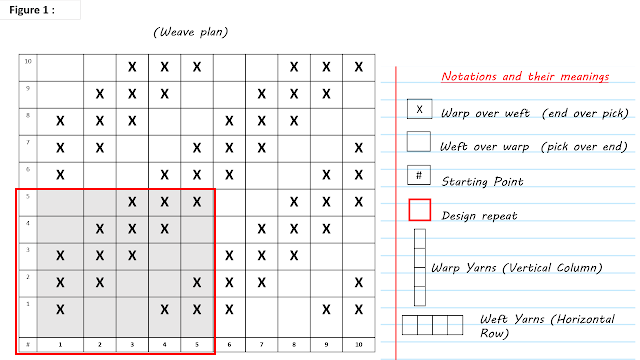
Let us consider basic 3/2 warp way twill weave motif (3 up 2 down). The repeat size for this selection will be 3+2=5 i.e. (5 x 5)
Step-II: Draft plan
It communicates two main pieces of information to the draft reader-
- It showcases the number of shafts (heald frames) required to complete the design.
- The draft plan, (known as threading plan) indicates the order of insertion of the warp yarn through heddles of each shaft to get the desired pattern.

The next step is to plan the order of warp yarn insertion in each shaft. This is automatically determined once we find out number of shafts required by grouping the similar warp yarn interlacement. (In figure 2, look at the table Determining the number of shafts)

Step-III: Formulating Lifting plan
Figure-4 shows how the lifting plan matrix is positioned in the draft, meanings of rows, columns, and their relationship with the shafts.
Before beginning, do remember that the pegs (in a dobby loom) or levers (in a table loom) are to be lifted in such a manner that we ultimately get the weave plan that we had decided in step-I.
You must keep in mind that when the levers or pegs are lifted up, they lift the corresponding shaft to which they are connected. That means, shafts (1,2,3,4 and 5) must be controlled with one lever or peg each (i.e. L1, L2, L3, L4, L5 respectively, figure 4); hence, we require 5 of them for the weave plan that we have considered.
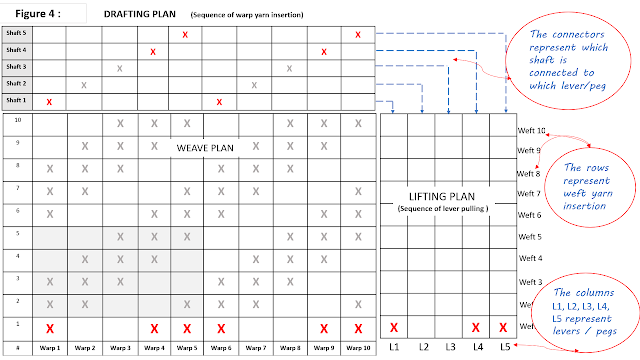
Now, look at the Figure-4. Note that, for the warp yarns (i.e. Warp 1, Warp 4, Warp 5, Warp 6, Warp 9, Warp 10), before insertion of first weft yarn (Weft 1), we need to lift shaft 1, 4 and 5 for which we need to lift lever L1, L4, L5 (all denoted with X in the diagram).
In a similar manner, lifting order is decided before insertion of weft 2,3,4,5 and so on while looking at the weave plan and the shafts that need to rise. The final lifting plan is shown in Figure 5.
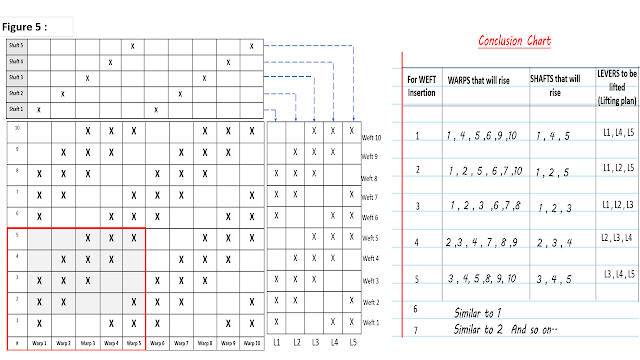
Look at the Conclusion Chart shown in Figure-5. It shows the interrelationship between warp yarns, weft yarns, levers/pegs (lifting plan) and shafts to be lifted. In a similar manner, lifting plans can be prepared for different weave plans. As a signing off note, do not forget to clearly represent the notations for clear communication of your draft. (Refer to figure1 for a sample format)
References:
- Hand Weaver’s Pattern Directory by Anne Dixon
- Woven Textiles: A Designer’s Guide by Sharon Kearley
Published:15 Jul 2020
About the Author:
Aayushi Kumar, an NIFT, Kolkata graduate, and Co-founder of Ednam Solutions Pvt Ltd is working in the field of female healthcare and hygiene, making smart garment.
Her interests include sustainable fashion, functional garments and luxury brand management.


Leave a Reply